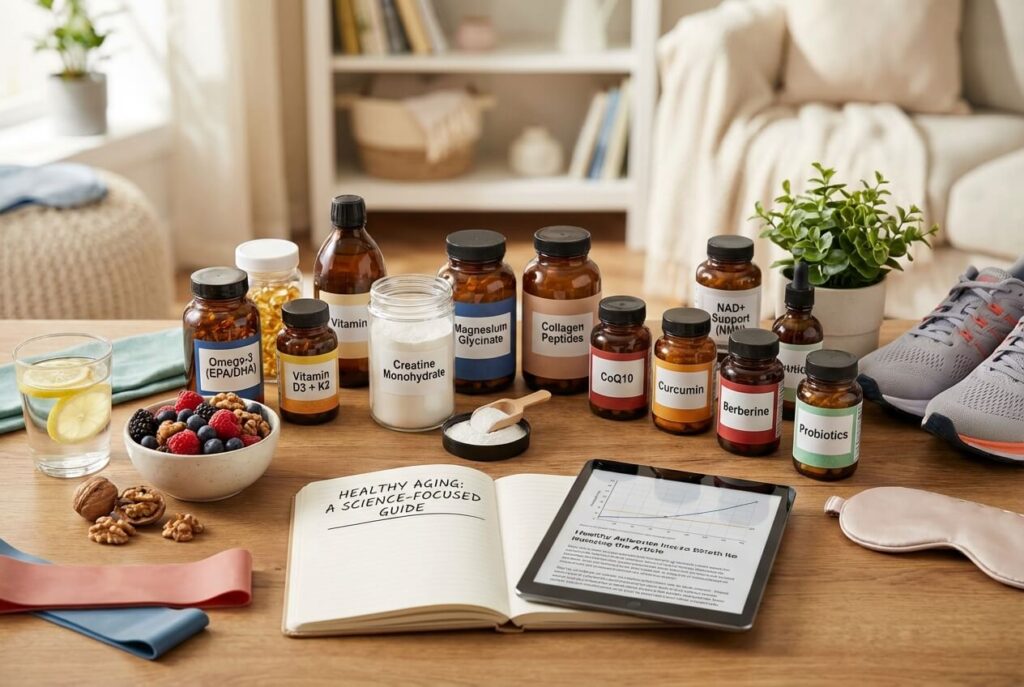
Healthy aging isn’t about “stopping time” — it’s about supporting the biology behind energy, cellular repair, metabolism, and inflammation. In recent years, longevity research has highlighted several evidence-informed supplements that may help support healthy aging when combined with the basics: sleep, movement, protein, and a nutrient-dense diet.
Below you’ll find a practical, science-focused overview of 10 popular anti-aging supplements, what they’re typically used for, and how to choose them wisely.
Disclaimer: This article is for educational purposes and does not replace medical advice. If you are pregnant, nursing, have a medical condition, or take prescription medication, consult a qualified healthcare professional before using supplements.
Quick takeaway: What matters most
- Consistency beats “stacking” too many products.
- Prioritize quality (3rd-party testing, transparent labels, reputable brands).
- Track 1–2 outcomes at a time (sleep, energy, skin, training recovery) before adding more.
1) Omega-3 (EPA/DHA)
Omega-3 fatty acids support cardiovascular health, brain function, and a balanced inflammatory response — all key pillars of healthy aging. Look for a product that clearly lists EPA + DHA per serving, not just “fish oil” mg.
How to choose
- Prefer triglyceride or high-purity forms; check oxidation/freshness if available.
- Transparent labeling for EPA/DHA.
- If you don’t eat fatty fish 2–3x/week, omega-3 is often a solid base supplement.
2) Vitamin D3 (often with K2)
Vitamin D supports immune function, muscle performance, and bone health — all critical for longevity. Many people have low levels, especially in winter or with minimal sun exposure.
How to use
- Consider a blood test (25-OH Vitamin D) to personalize dosing.
- Take with a meal containing fat for better absorption.
- K2 is often paired with D3; discuss with your clinician if on blood thinners.
3) Creatine Monohydrate
Creatine is not just for athletes. It supports muscle strength, power, and may support cognitive function — important because muscle is a longevity organ. It is one of the most studied performance supplements.
How to choose
- Choose plain creatine monohydrate.
- Consistency matters more than timing.
- Drink enough water and ensure adequate protein intake.
4) Magnesium (Glycinate or Citrate)
Magnesium is involved in hundreds of reactions linked to energy production, sleep quality, and nervous system balance. Many people don’t get enough from diet.
Which form?
- Glycinate: often preferred for relaxation and sleep.
- Citrate: can help with regularity (may be too strong for some).
5) Collagen Peptides (with Vitamin C)
Collagen supports skin elasticity and joint/tendon health. The body needs vitamin C for collagen formation, so pairing collagen peptides with vitamin C (from food or supplement) makes sense.
What to look for
- Hydrolyzed collagen peptides (Type I & III are common for skin).
- Minimal additives; mix easily in coffee/tea/smoothies.
6) CoQ10 (Ubiquinone or Ubiquinol)
CoQ10 plays a role in mitochondrial energy production. It’s often used for energy, cardiovascular support, and as a supportive antioxidant.
Tip
- Take with food (fat-containing meal).
- Ubiquinol is a reduced form often marketed as more bioavailable.
7) Curcumin (Turmeric Extract)
Curcumin is widely researched for supporting a balanced inflammatory response and joint comfort. Bioavailability matters — plain turmeric powder is not the same as standardized curcumin extracts.
How to choose
- Prefer a formulation with improved absorption (e.g., phospholipid complex or similar).
- Look for standardized curcuminoids content.
8) Berberine (metabolic support)
Berberine is commonly used to support glucose metabolism and insulin sensitivity — a major longevity lever. It’s sometimes compared to lifestyle interventions like improving diet quality and walking after meals.
Notes
- Best used as part of a plan with nutrition and activity.
- May interact with medications — check with a clinician if you take prescriptions.
9) NAD+ Support (NMN or NR)
NAD+ is a coenzyme involved in cellular energy and repair. NMN (nicotinamide mononucleotide) and NR (nicotinamide riboside) are popular for supporting NAD+ pathways in longevity research. Human evidence is still evolving, so treat this as an “advanced” category.
How to approach
- Choose reputable brands with clear testing and identity verification.
- Track one outcome (energy, recovery, sleep) for 4–8 weeks before changing anything else.
10) Probiotics / Gut Support (case-by-case)
The gut microbiome influences digestion, inflammation, and immune function. But probiotics are highly individual — the “best” one depends on symptoms, diet, and tolerance. Many people start with prebiotic fiber and fermented foods first.
Practical approach
- Start with food: yogurt/kefir, sauerkraut, kimchi, fiber-rich plants.
- If using a probiotic, pick a strain-specific product aimed at your goal.
How to build a simple anti-aging supplement stack
If you want minimal spend and maximum clarity, start with a “foundation stack” and only then add targeted extras.
Foundation (most people)
- Omega-3
- Vitamin D3 (based on bloodwork if possible)
- Magnesium
- Creatine (especially if training)
Targeted add-ons (choose 1–2)
- Collagen (skin/joints)
- CoQ10 (energy/mitochondria)
- Curcumin (joints/inflammation)
- Berberine (glucose/metabolism)
- NMN/NR (advanced longevity interest)
FAQ
Which supplement is the #1 for anti-aging?
There isn’t one “magic” supplement. The best ROI usually comes from foundations like omega-3, vitamin D (if low), magnesium, and building/maintaining muscle through training + protein.
How long until supplements show results?
Some effects (sleep, recovery) may show within days to weeks. Others (skin, biomarkers) often take 8–12+ weeks. Track one or two changes at a time.
Can I take all 10 at once?
It’s better not to. Start with 2–4 basics and add one at a time so you can tell what helps (and what doesn’t).
Conclusion
Anti-aging is a long game. The smartest plan is to anchor your routine in sleep, movement, strength training, protein, and micronutrients — and then use supplements strategically. If you’d like, I can help you turn this into a monthly content plan (articles + categories) so the blog starts building organic traffic.
Scientific References & Sources
Selected peer-reviewed studies, meta-analyses, and clinical guidelines related to the topics covered in this article.
Creatine
- International Society of Sports Nutrition (ISSN) Position Stand: Creatine supplementation (2017). PubMed | Full text
Omega-3 (EPA/DHA)
- Review/meta-analysis overview of omega-3 fatty acids and cardiovascular outcomes. PMC (full text)
- Omega-3 dosage and cardiovascular outcomes (systematic review/meta-analysis). PubMed
- Circulating marine omega-3 levels and mortality (large cohort analysis). Nature Communications
Vitamin D
- Serum 25(OH)D and all-cause mortality (systematic review/meta-analysis). PMC (full text)
- Vitamin D supplementation and mortality (systematic review/meta-analysis). BMJ
Collagen peptides (skin)
- Oral collagen supplementation and skin outcomes (systematic review/meta-analysis). PMC (full text)
- Collagen supplement trial: hydration, elasticity, and skin roughness (RCT). PMC (full text)
Coenzyme Q10 (CoQ10)
- CoQ10 for heart failure (Cochrane review). Cochrane Library
- CoQ10 in heart failure (systematic review/meta-analysis; RCTs). PMC (full text)
Curcumin (turmeric extracts) & bioavailability
- Review: curcumin formulations and bioavailability considerations. PMC (full text)
- Curcumin antioxidant potential (meta-analysis of RCTs). Antioxidants (MDPI)
Berberine (metabolic support)
- Berberine and type 2 diabetes outcomes (meta-analysis of RCTs). PMC (full text)
- Systematic review/meta-analysis: berberine in metabolic disorders. Frontiers (full text)
NAD+ support (NMN)
- NMN supplementation: randomized, double-blind, placebo-controlled trial (NAD biomarkers; safety/tolerability). PubMed | PMC (full text)
- NMN in aged men: placebo-controlled RCT (NAD-related metabolites). Nature Aging
Magnesium & sleep (context)
- Dietary magnesium intake and sleep quality (observational evidence). PMC (full text)
Probiotics / prebiotics & gut health
- American Gastroenterological Association (AGA): guideline statement on probiotics (limited evidence for many conditions). AGA (press release) | NIH ODS: Probiotics fact sheet
- World Gastroenterology Organisation (WGO) guideline: Probiotics & Prebiotics (PDF). WGO PDF
Note: Evidence varies by supplement, dosage, formulation, and individual context. Always consider medication interactions and consult a qualified professional when needed.
I started writing down one thing at the end of every day — what I actually managed to do. Not a to-do list, not plans. Just one small win. It’s surprising how quickly it shifts your perspective.
https://www.differentpharm.com/timeless
This is one of the best product that I ever tried